
Life and love at the Polymarket grocery store
I tried out some scene reporting

I am not a frequent gambler, for two reasons: I can never remember the rules of card games, and also I am prone to bouts of overconfidence that would surely result in financial ruin if I ever let myself get really into it. I’ve won and lost small amounts of money on Kalshi, and the experience informed me that—like anything else—there is a logic to prediction markets, and that logic is possible to game. The downside is that the average person will lose quite a bit of money before they figure it out. That is why they shouldn’t exist. I’m not a saint, I don’t want a nanny state and I’m not against gambling as a concept; who am I to deny my fellow addictive personalities the rush of high stakes and delusion? The arguments that prediction markets are immoral because you can bet on things like the genocide in Gaza or the coup in Venezuela have always been unconvincing to me, because it would be very easy for these companies to simply take those pages down but ultimately the underlying problem would still stand: that it is simply too easy to lose all your money.
These companies know this, and they want to remove every ounce of friction out in the world preventing people from risking it all. That’s why you’re starting to see Polymarket and Kalshi everywhere; Polymarket recently announced a baffling partnership with Substack, claiming “journalism is better when it’s backed by live markets.” Your guess is as good as mine as to what that actually means, but major outlets seem to agree. Kalshi and CNN struck a deal in December, adding a ticker with real-time Kalshi data updates on air. Prediction betting boosters believe that the markets, in aggregating the wagers of millions of people, are an arbiter of truth that is greater than the authority vested in journalists to represent reality.
I could write a whole separate essay about this worldview and how similar it is to the logic behind language learning models exhibiting “intelligence”, and maybe I will. But right now I want to talk about how these markets are trying to enter the real brick-and-mortar world. I have been unable to think about anything other than the Polymarket free grocery store pop-up that was in the West Village last week. Billed “New York’s First Free Grocery Store”, the “store”, if you can call it that, was employing somewhat misleading marketing; what was little more than a marketing stunt and tax write-off was branded as a public service. It’s the same sleight of hand that they use when they brand themselves as a journalistic enterprise, not that it really matters to the people who get free food out of it. Whether or not Polymarket actually cares about the people who were standing in line for hours for their turn to shop, they still got to go home with groceries that would have cost money otherwise. I knew I had to go see it for myself, because it’s one thing to witness the twisted logic of prediction markets on the internet. It’s quite another to see it in real life.
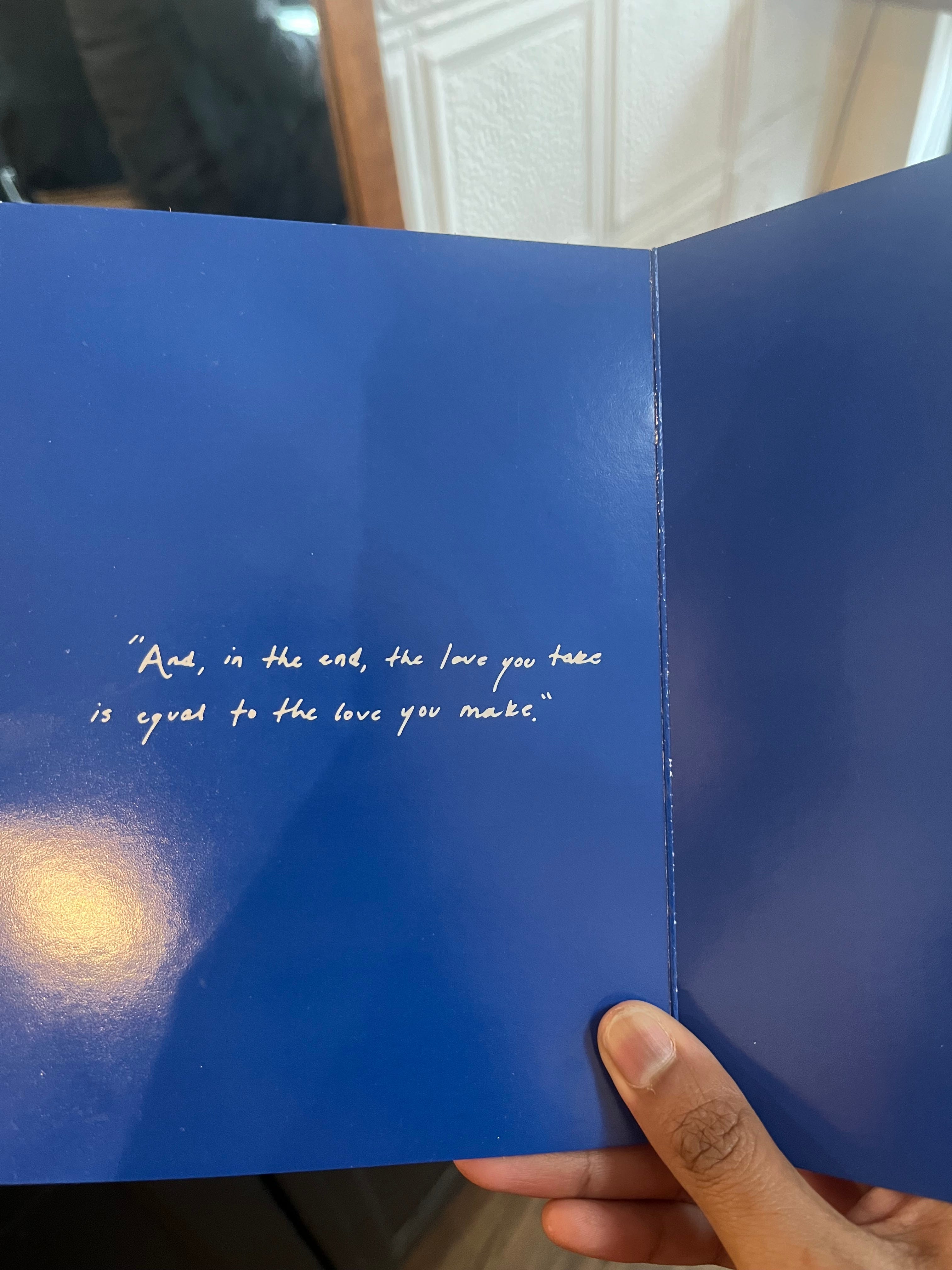
On Valentine’s Day I tried to go to the store. I had originally planned on going in the morning so that it wouldn’t cut into the rest of my day, but that morning I woke up late and hungover and by the time I got myself together and made it out to the West Village they had already closed. The security guard gave me a Polymarket-branded Valentine’s Day card, which had no text besides a line from The Beatles song “The End”: “And in the end, the love you take is equal to the love you make.”
The next day I returned. The line wrapped around the block, so I went to the back. A few minutes later, an employee told the people standing near me in line that unless they had a ticket they would most likely not be able to enter. I asked the security guard how to get a ticket. “We gave them out around 8:30 this morning,” he said. “People were standing in line at 5am.” (For context, Polymarket’s website and promotional materials said the store would open at 12pm that day.) I told them I was a journalist and didn’t want to shop, but they wouldn’t let me in. No matter. The inside of the store was, at most, a curiosity. What I was here for were the shoppers.
The first thing you need to know about the Polymarket free grocery store is that the people in line were mostly women, old and young, primarily Black, Asian and Latino. Several of the people I tried to talk to did not speak much English, if at all. If this strikes you as being a totally different demographic than the typical Polymarket user, you’d be right. The average prediction market bettor is statistically young, male, educated, relatively well-off. Prediction markets aren’t (yet) as popular as more traditional forms of sports betting, and the appeal hasn’t broken through to different facets of our segregated class society.
None of the people I talked to in line had heard of the app before, besides one young woman who told me a lot of her guy friends were really into sports betting, and that it was a point of camaraderie between them, especially in corporate settings. I asked her if prediction betting was at all appealing to her, or if any of her female friends were into it. She scoffed at the idea. “Guys like sports betting for the adrenaline, but we get that from shopping,” she said. I pointed out that most of the line was made up of women. “Yeah, it’s probably because women grocery shop.” She told me none of her friends’ boyfriends did any cooking or grocery shopping and they wouldn’t know how even if anyone expected them to. It was hard to keep a straight face during this exchange. It pains me to say this, about the least sympathetic class of people on Earth, but I’m concerned about men in their early 20s.
A 24-year-old girl named Tomi who had recently moved to Manhattan to pursue a career in fashion told me she had heard about the store on TikTok, and that she was planning on making a TikTok about the experience. “I know people are saying they’re gentrifying food pantries, but they’re feeding the community, so I don’t care who does it.” I asked her if she had heard of Polymarket before. “No, but I looked it up, it’s a crypto thing, right?” she said. I briefly explained what a prediction market was. Her face fell. “Oh no,” she said. “Are we turning into Idiocracy?” A woman named Divine from Harlem told me she had also found out about the store on TikTok, and at first she had thought it was fake, but then she saw it on cable news. “This is a social experiment, right?”
I found myself explaining to a lot of people what prediction markets were. Two grad students, Junzhe and Peter, who had taken a bus all the way from Jersey City, told me they had heard about the store watching Fox 5 News, and had assumed it was a government program. When I gave them the spiel, they both fell silent. “That’s fucked up,” Junzhe said. They had both moved to America from China four years ago. I asked them if they liked it here. “It’s pretty much the same,” they said. “The same technocapitalist bullshit everywhere.” Put these guys in charge!
I asked people about their relationship to gambling; if it was in their life at all, if they found it interesting, what kind of gambling they were most familiar with. Two college-aged guys from Jamaica, Queens told me they weren’t into sports betting and they didn’t know anyone who was. This was truly shocking to me, as I would assume they were the prime audience. The only gambling they had any experience with were “gacha games”, or games that employ a kind of lottery-type mechanism (like claw machines at arcades, but online), and speculating on Pokemon cards. A 55-year-old woman named Lynette who had taken the train down from the Bronx told me unprompted that she had a long history with gambling. I asked her what kind. “Stocks, futures, options, crypto, I do it all,” she said, proudly. She was very interested in the prediction markets and was planning on asking a friend who works in finance for advice on how best to go about it. I was struck by how gambling and traditional financial speculation were one and the same to her.
Despite not being allowed inside, I still got some free stuff: a water bottle and a latte, from store employees were who were passing them out to people in line. An employee told me the store would be coming back soon, so maybe I’ll get it on the action next time. Also, a cute guy asked me for my Instagram, so maybe if we get married Polymarket can sponsor our wedding.
More:
Most of you probably already saw Alysa Liu’s gold medal-winning performance but if you haven’t, you should. Every day you really can just wake up and choose to find joy and meaning in your life’s work!!! And doing so whether or not you receive external validation is the ultimate reward!!!! The human spirit can triumph over all obstacles and you can do anything on your own terms if you are generous enough to yourself to believe it!!!!! You know I cried!!!!!
Curtis Sliwa is a fan of the Chainsmokers. The New York mayoral election took up so much of my brain space that this actually was not new information to me.
Harper’s Magazine has been killing it with the tech pieces lately. Despite the warnings of virtually everyone I have ever met, I have an enduring interest in the Bay Area. I wish I could say it’s because I love its historic counterculture and that I’m sad it turned into what it has, but that’s only a little bit true. Its appeal to me is what it is right now. I want to go to the beach in eternal 65 degree weather. I want to ride in a Waymo. I want to eat dim sum and In-N-Out and buy peptides from WhatsApp dealers and go to parties where no one drinks and everybody has a blog. Not all the time, of course, that’s why I live in New York. But I love the idea of one of America’s great cities turned into nerd mecca; I think in some ways I’m kind of like that too. It’s really too bad that they’re destroying the world. Maybe it’s a small comfort that they’re destroying their own lives along with it.
Thanks for reading Terms and Conditions! If you liked this newsletter, consider upgrading to a paid subscription, or forwarding this to a friend. xoxo TM