
So what do you really think about AI?
A very scientific public opinion survey

I frequently work out of a coworking space that functions as a clubhouse of sorts for post-rationalist tech workers in New York. I’m not involved in the community and I don’t share their worldview, but it’s pretty quiet, close to my apartment, I have 24/7 access, and the people are quite nice. Talking to them is usually interesting and helps inform my view of the industry. I’ve tried other tech-focused spaces with the idea that observing them will be generative, and it is, but the people are usually much worse to be around. It’s a good deal!
Last week on my way there, I saw a flyer taped to a nearby utility pole. “Too much AI?” it asked. “Can’t stop doomscrolling? Worried about the future?” The pull tabs had a phone number: 1-231-HIT-US-UP. I tore one off and called in.
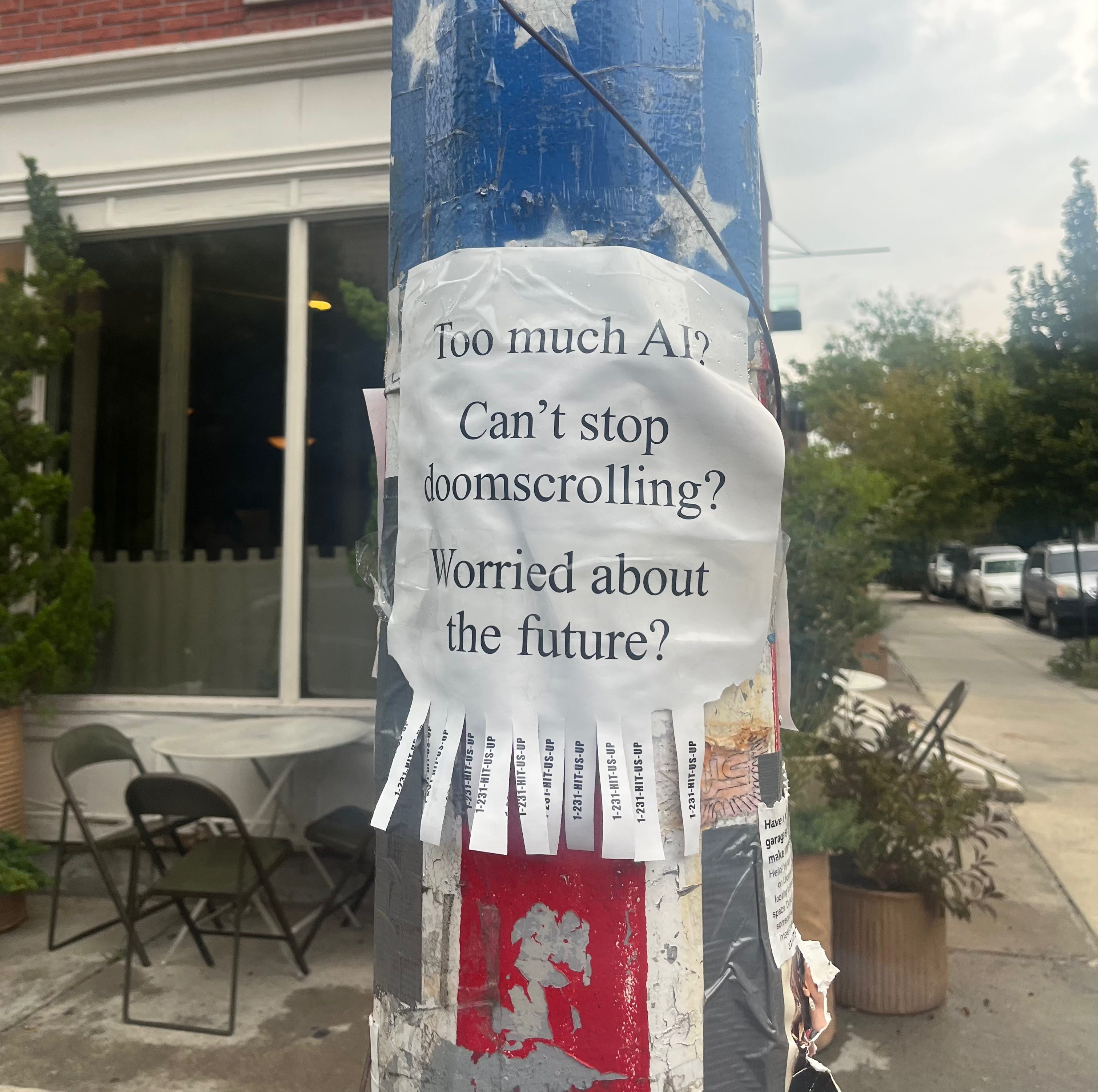
Cue elevator music. “Hello,” a disembodied voice said to me. “You’ve reached the AI Dread hotline. We’re all feeling it. The nagging worries that AI can do our jobs. So if you’d like to put your existential dread on hold for a few minutes and reconnect with the human side of work, please select from the following options.” It read out the menu: “Press 1 to hear the sales team practice their new pitch. Press 2 to hear 4 minutes of office ASMR. Press 3 to hear what happens when Emily brings her dog to the office. Press 4 to hear the team throw a surprise party. Press 5 to hear Bridget debrief a first date. Press 6 to hear Emily and Isaac complain about the temperature of the office. Press 7 to tell us what you really think about AI.” And if none of those options appealed to you, there was another: “To return to a feeling of existential AI dread, simply hang up.”
I pressed 1, which brought me into the middle of “the sales team” considering a new phrase: “We want to empower consistent user throughput on your platform.” Somebody points out that it would be too much to introduce the word “throughput” as a concept to potential customers when you’re already trying to sell them on the product. (I had to look up what throughput means: according to Merriam-Webster, it’s “the amount of something (such as material, data, etc.) that passes through something, such as a machine or system”.) They decided against it. “What makes us different,” someone else continued, “Isn’t just the numbers. It’s that we’re people people.” “People people!” they exclaimed in delight.
I hit 2, curious about what “office ASMR” could possibly be. I heard the sound of a printer, beeping sounds, the ding of an elevator bell, and a lawnmower. It was, in a strange way, comforting. It also did not sound like a modern workplace—who is printing out this much paper on a daily basis in 2026? But the other clips felt more modern.
I pressed 5 to hear “Bridget” talk about a first date she went on, where disaster struck: after ordering a bunch of food, her date went to the bathroom and never came back. “And I’m pretty sure the name he gave me was not the same name,” she said, “Because every time I was like, Michael! He was NOT registering it.” Poor girl.
“And you know me, I use names,” she continued, “because I want you to feel seen and heard.”
It was a corporate stunt, I later learned. The SF Standard reported that a few weeks ago, billboards with the AI Dread Hotline number went up in San Francisco, paid for by Notion, the AI productivity company.
Notion is trying to convince the public that they, too, are people people. They’re not like other tech companies and they want you to know it. They’re the cool tech company, the one that understands you’re scared about the future, that you’re worried about staying employed. They, too, want you to feel seen and heard.
What, though, does any of this have to do with the people? The marketing stunt has only been up in New York and San Francisco, and even then only in places where large amounts of tech workers congregate. I stop to look at flyers posted on utility poles all the time and I’ve only ever seen this one right in front of my coworking space, presumably for the audience of the people in it, almost all of who work in tech and who think about AI significantly more than the general population. Is the white-collar workplace a site of nostalgia? I’ve made close friends through work and have appreciated the camaraderie that can organically form in those settings. I don’t think people’s fears, though, center on this. I think they’re more concerned about losing their jobs than the “human side of work”, whatever that means.
I didn’t leave a voicemail with my own opinions on AI (where to even begin?) but, according to the SF Standard, as of July 24, two hundred people left voicemails: one noting that they would like to replace all AI with Corbin from Love Island (agreed), another of someone screaming for 15 seconds straight. Notion doesn’t plan on releasing the voicemails to the public, but I’d like to know what the people think about AI. So I created my own public opinion survey to find out, and I’d love to hear from you! Your answers will be kept anonymous, and I’m not requiring contact information unless of course you’d like to let me know who you are or if you’d like to be added to this email list. You can fill it out here.
Thanks for reading Terms and Conditions! If you liked this newsletter, consider upgrading to a paid subscription, or forwarding this to a friend. xoxo TM