
The most American thing to ever happen
God, it's all just so sad

I’ve been hyperfixating on the CEO shooter ever since we found out who he is, probably annoying most of my friends. (Sorry for all the texts, I’ve just had a lot of thoughts!) A persistent thought running through my head: This is all so utterly American. If it had been a work of fiction it would be the Great American Novel. Just as tragic as it is funny, although I have laughed quite a bit about the whole thing. This is my favorite tweet about the situation; it’s so funny that this random girl who went to school with him remembers him primarily as a cutie, and it’s even funnier that her major takeaway from finding out one of her classmates from college committed a high-profile murder was that he’s still got it. I mean, is she wrong? Just look at him! Sorry, his mugshots are too good! A real Fleabag looking too good at her mother’s funeral kind of situation: they keep messing up his hair but it just keeps falling in a really chic way.
Like everyone else, I have my own favored theory of the case. If you want a summary, basically I believe he did it. I don’t think he was framed because he’s rich and likable so he seems like an odd target for the cops to pick when they could have chosen someone poor and thus less likely to elicit sympathy. I think the feds found him with illegal surveillance measures and they made up the McDonald’s story to cover their tracks. I think it’s possible he was talking to other people even if, as he mentions in his manifesto, he didn’t have any accomplices. I also think there’s a mob connection somewhere, although I have no evidence to support this last point and I mostly just think it would be fun.
I’ve been watching the Sopranos lately (classic unemployment activity) and it’s hard not to draw parallels. I’m not just saying this because he’s Italian. The Sopranos is an excellent show about the American Dream and how coming to terms with the fact that it doesn’t exist can drive anyone insane. It’s about the precarity baked into American life that few of us are truly immune to. The Sopranos have a huge house in a wealthy neighborhood. They send their children to private schools. Tony is big, he’s strong, he’s armed to the teeth and feared by everyone he meets, both inside and out of the mob. Their similarly well-off neighbors view them with disgust because their wealth was obtained through illegal means, but the Soprano family knows something they don’t: they are acutely aware of their own vulnerability. On a practical level, Tony is always at risk of losing his life, putting Carmela and the children at risk of financial ruin. On a more philosophical level, the mob is on the decline and the old days are never coming back, although it’s not like the old days were any good anyway. Tony Soprano’s life as a mob boss is utterly unrelatable to most of us, except it’s not. His panic attacks, his unrelenting depression, his longing for a past that never truly existed—the “strong, silent” Gary Cooper type was a Hollywood invention, after all—are right at home in 2024. I don’t know if I’ll ever be able to afford a home or have a child. I feel like I came in at the end too.
I don’t see the point in arguing about whether you should celebrate the death of someone who has caused so much suffering because I think that’s generally already been decided for us. Brian Thompson will be remembered only as a victim by the powers that be. Ultimately, his life was no more protected than that of his victims—all the people that UnitedHealthcare has denied essential coverage to, often with fatal consequences—but for his life to become precarious is a crime, while the lives of so many that fall victim to the health care system aren’t necessary to protect to generate shareholder value.
What’s striking about Luigi Mangione to me is that he was so normal. By all accounts, he was nice, smart, thoughtful and well-liked. No history of violence or aggression that we know of. What happens to someone that they would snap in this way? The kind of debilitating back pain he had and humiliation he undoubtedly suffered trying to get his insurance company to cover it would make anybody go crazy, probably. But tens of millions of people across this country have similar stories about themselves and their loved ones. They don’t all pick up a gun, but in this country, even in its gated communities, we are passively subject to so much violence and there’s no way it doesn’t affect us. I think his trajectory shows that we’re all a bit closer to that kind of violent act than we’d like to believe ourselves capable of.
I am amused by all of the talking heads on Twitter who are astonished that anyone could hold such a variety of idiosyncratic beliefs and still hate the health insurance industry, because they’re basically telling on themselves that they did not go to parties in college, or possibly any time before or after that. Anyone who has spent even a passing amount of time in a collegiate frat house has met a thousand of him: boys who walk around on this earth like they own the place, white but not exclusively so, often rude and entitled but occasionally very kind. An interesting mix of distrust towards authority and belief in institutions, since they benefit so greatly from them. “To the Feds, I'll keep this short,” Luigi wrote, “because I do respect what you do for our country.” When I was in college I was fascinated by these guys, equal parts attracted to and repulsed by their outsized confidence. Mostly, I was jealous of them. I wanted to feel like the world was made for me in the way that they so obviously did.
As I’ve gotten older, their intrigue has mostly faded for me, although sometimes I still feel a little thrill drinking cheap beer or listening to a song from 2016. I’m not sure they all have that kind of confidence anymore. How can anybody, in 2024? I am sure plenty of former frat bros call their insurance company to contest a claim every day. Tech companies laid off more than 130,000 workers this year and those jobs don’t seem to be coming back. The average one bedroom rental in New York is $4,110, up more than twenty percent from before the pandemic. You have to make at least $160,000 a year to be able to qualify for that. The evidence is all around us that we are all vulnerable to the particular cruelties of this country even if you are privileged enough to be out of the immediate line of fire. Some people choose to pretend that’s not true, but that’s kind of a losing game.
Luigi was laid off from his lucrative tech job sometime in 2023, the same year he had back surgery for chronic pain, and there’s no indication he had gotten another one since. Perhaps he also felt his own American Dream slipping away from him. We don’t know for sure what he thought about his own situation, although some Reddit posts shed light on how chronic pain changed his life; his manifesto, available in full here, is pretty impersonal. No mention of his own struggles with the health care system or debilitating back pain or inability to continue the active lifestyle he treasured so much. It’s not about him at all, except to describe in very brief detail how he did it in the first place. Instead, he takes the opportunity to lay out why he did it, and no one needs to be told what the insurance companies do or how they profit off of immiserating the public. You don’t have to be someone who supports Medicare for All politically to know this is evil. We are all eventually forced to come to terms with our own precarity. Evidently he was the first to face it with such brutal honesty.
this is first all-encompassing Take on the situation that I agree with. really enjoyed reading this :)
Part 2/3
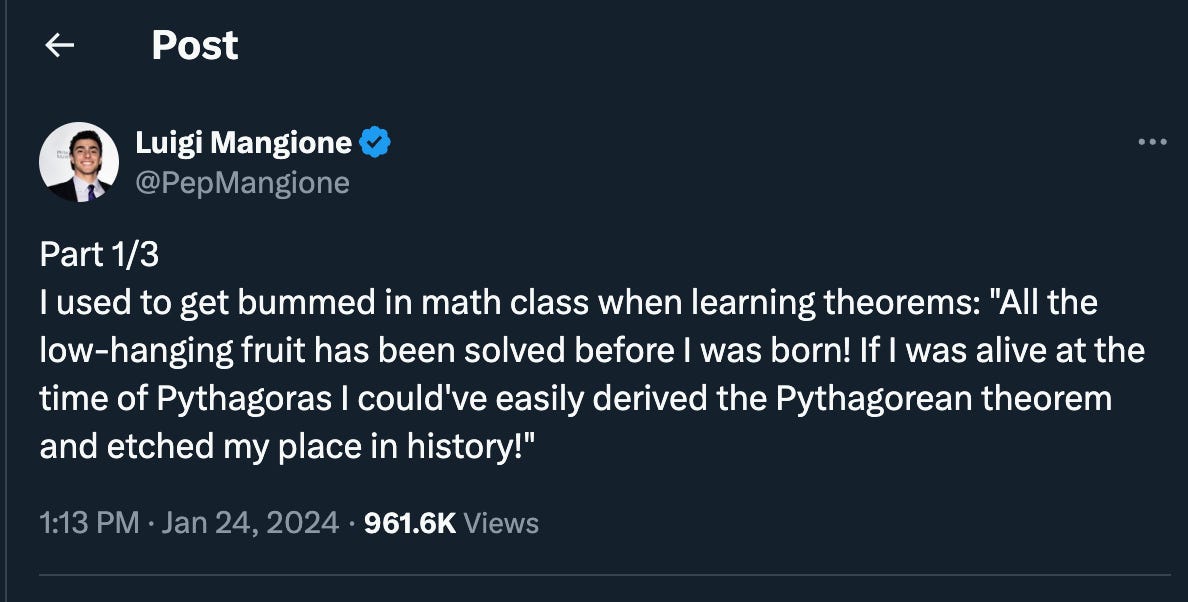
“But now I feel lucky for my 21st Century education. I get to simply download the knowledge of who came before me, allowing me to stand on their shoulders and ponder new problems they never would’ve had access to.” -Luigi Mangione